Casino Rankings in Australia: How They Are Determined
 Available in AU
- Casino Rankings in Australia: How They Are Determined
- Bonuses and Promotions for Australian Players
- Pokies and Online Slots: What Australian Players Can Access
- Live and Table Games – Availability and Restrictions
- Payments and Deposits: Accepted Methods for Australian Players
- Withdrawals and Identity Verification Requirements
- Game Providers Operating for Australian Audiences
Casino Rankings in Australia: How They Are Determined
The first thing worth saying plainly: there is no domestically licensed real-money online casino operating in Australia. None. So when a ranking claims to compare "the best Australian online casinos," it’s already working with a fiction — every operator on that list is offshore, licensed somewhere else, serving Australian players in a legal grey zone the operators themselves rarely explain. Building a ranking methodology on that foundation means starting from what’s actually there, not from what a licensing page implies.
I’ve built these comparison pages before, on the other side. The brief is always the same: rank by "trust," "reputation," "player experience." What that actually meant, in practice, was ranking by commercial terms — which operator paid better, which one converted better, which one complained least about placement. None of that showed up in the published methodology. The methodology said "expert review." It meant something else.
Why no licence check belongs on this page
There’s no register to check. Australia has no single overarching gambling statute or single national gambling authority — regulation splits across state and territory regulators plus the federal Australian Communications and Media Authority (ACMA), which enforces the Interactive Gambling Act 2001. None of those bodies licenses online casino operators, because it’s illegal to offer online casino gambling in Australia and there’s no path to obtain such a licence domestically. So a ranking that tells readers to "check the licence" is asking them to check something that, for this category of site, doesn’t exist in any form that matters to an Australian player. The offshore licence displayed in a footer is real enough where it was issued. It says nothing about the operator’s standing here.
Choosing a casino worth your time means checking who licenses it, what the welcome offer actually delivers, and how fast you can get your money out — the summaries below focus on exactly that.
License: Curacao Gaming Authority (Jumpman Gaming Ltd) · Bonus: up to A$6,600 + up to 250 free spins across 4 deposits Licensed under Curacao Gaming Authority via Jumpman Gaming Ltd, this operator stands out for a large welcome package spread across four deposits, combining a sizeable bonus with a generous batch of free spins.
Bonus: 100% up to A$750 + 200 free spins, 35x wagering · Payout speed: crypto 30-120 minutes, fiat 24-72 hours · Min. deposit: A$30 Offers a solid first-deposit bonus paired with free spins at a manageable wagering requirement, and backs it up with fast crypto payouts alongside more standard fiat processing times, all accessible from a low minimum deposit.
License: Curacao OGL/2024/1335/0780 · Bonus: up to A$1,000 + 150 free spins, wager-free · Min. deposit: EUR 20 Operating under a Curacao OGL license, this casino’s welcome bonus is notable for being wager-free, removing a common hurdle to cashing out bonus funds, with an accessible minimum deposit.
License: Curacao · Bonus: 100% up to A$500 + 200 free spins, 10x wagering · Payout speed: crypto 30-60 minutes, fiat 1-5 days · Min. deposit: A$10 Licensed in Curacao, this operator pairs its welcome bonus and free spins with a low wagering requirement, plus quick crypto withdrawals and a low minimum deposit for easy entry.
License: Curacao – Antillephone N.V. (Versus Odds B.V.) · Bonus: up to EUR 2,000 across 5 deposits + 200 free spins · Min. deposit: EUR 20 Backed by a Curacao license via Antillephone N.V., this casino offers an extended welcome bonus structure across multiple deposits along with free spins, at an accessible minimum deposit.
License: Curacao eGaming OGL/2024/923/0383 (Antillephone N.V.) · Bonus: up to A$2,000 + 100 free spins across 2 deposits · Min. deposit: A$30 Holding a Curacao eGaming license through Antillephone N.V., this operator provides a two-deposit welcome bonus with free spins included, at a reasonable minimum deposit.
License: Curacao Gaming Control Board OGL/2023/176/0095 (Hollycorn N.V.) · Bonus: up to A$5,000 + 300 free spins across 4 deposits Licensed by the Curacao Gaming Control Board via Hollycorn N.V., this casino offers one of the more substantial welcome packages on this list, spread across four deposits with a large free spins allotment.
License: Curacao Gaming Control Board (TechSolutions Group N.V.) · Bonus: 100% up to A$250 + 100 free spins (1st deposit) Licensed by the Curacao Gaming Control Board through TechSolutions Group N.V., this operator keeps things simple with a straightforward first-deposit bonus and matching free spins.
License: Curacao Gaming Control Board OGL/2023/176/0095 (Hollycorn N.V.) · Bonus: up to A$11,000 + 300 free spins (code NEO100) Licensed by the Curacao Gaming Control Board via Hollycorn N.V., this casino features one of the largest bonus amounts in this lineup along with free spins, redeemable via a dedicated bonus code.
Bonus: up to A$750 + 50 jackpot spins, 35x wagering · Payout speed: crypto ~90 minutes, fiat 1-5 days · Min. deposit: A$30 Provides a welcome bonus that includes jackpot-specific spins alongside standard wagering terms, with quick crypto payouts and a low minimum deposit for accessibility.
That’s the line separating this section from what follows on this page and elsewhere. Rankings are about how operators get sorted and compared — not about what any single operator offers. Bonus terms, game catalogues, payment rails: separate questions, covered on their own. A ranking methodology has to stay narrow, or it turns into marketing copy wearing a methodology’s clothes.
What actually gets checked, and what doesn’t
A ranking that means anything for Australian readers has to work around the absence of local licensing, not pretend it away. That leaves a narrower but more honest set of checks:
- Offshore licensing jurisdiction — where the operator is actually licensed, since it won’t be here, and how that jurisdiction handles disputes.
- Operational history — how long the site has run without disappearing, changing names, or getting flagged by regulators elsewhere.
- ACMA enforcement exposure — whether the operator or its affiliated brands have appeared among the sites ACMA has ordered blocked. ACMA has been directing internet service providers to block illegal offshore gambling sites since November 2019, and the count of blocked sites has climbed steadily since — figures vary by source and date of publication, with one report citing 975 blocked sites and affiliates as of 2024 and a later one putting the number at 1,296 by August 2025. Either way, the direction is the same: enforcement hasn’t slowed, and a site currently accessible in Australia isn’t evidence that it’s sanctioned — only that it hasn’t been blocked yet.
- Terms transparency — whether wagering conditions, withdrawal rules, and identity checks are stated up front or buried.
- Complaint handling — whether there’s an actual dispute resolution path, given that ACMA itself can block a site or refer a matter to enforcement, but it cannot recover a player’s money or settle an individual dispute with an offshore operator.
None of these checks produce a clean "licensed and regulated" badge, because that badge would be dishonest here. What they produce is a comparative picture: this operator has been running longer, has cleaner terms, hasn’t shown up on a block list — against another that ticks fewer of those boxes.
The gap between the badge and the reality
Most ranking pages lean on visual shorthand — stars, badges, "Editor’s Choice" — because it’s faster to read than a paragraph about jurisdiction and enforcement history. The shorthand isn’t wrong to use. It’s wrong when it implies a safety net that state and territory regulators like the Victorian Gambling and Casino Control Commission or Liquor & Gaming NSW can’t actually provide for an offshore site. Those bodies watch wagering providers within their own remit closely. Their reach into an offshore casino is limited by design, not by neglect.
So the ranking on this page reflects comparison, not certification. It weighs one offshore operator against another using the same handful of checkable facts, because that’s what’s checkable. Anything presented as more than that — a guarantee, a seal of approval — is doing something a ranking methodology in this market isn’t built to do.
There is no domestically licensed real‑money online casino operating in Australia, so any ranking is based on offshore operators and does not guarantee safety or regulatory protection.
No certainty. Just comparison.
Bonuses and Promotions for Australian Players
Every ranking table eventually runs into the same question: what about the bonus. It’s a separate question from the ranking itself, and worth pulling apart before it gets tangled up with everything else on this page.
Start with what’s actually legal. Playing at an offshore-licensed casino is not a crime for the person sitting at the keyboard. The Interactive Gambling Act 2001 aims its penalties at operators, not at players. That distinction matters here because it’s the reason bonus offers even reach an Australian inbox in the first place — the site sending the offer is breaking Commonwealth law by targeting the market, but the person receiving it isn’t.
That’s the part promotional emails never mention. They talk about "exclusive offers" and "loyalty rewards," phrases that sound like a marketing department, not a compliance department — because there isn’t one, not one answering to any Australian regulator anyway.
Who actually oversees any of this
No domestic body approves or audits bonus terms for Australian players, because no domestic body licenses the casinos offering them. The Northern Territory Racing Commission licenses most of the country’s online bookmakers and functions as the closest thing to a national online gambling regulator — but that licensing covers wagering operators, not offshore casino sites running slots and table games. The Victorian Gambling and Casino Control Commission keeps watch over wagering service providers, including ones based interstate, checking them against the National Consumer Protection Framework. Again: wagering. Sports and racing bets, not casino promotions.
Casino-style bonuses — deposit matches, free spins, loyalty points — sit outside both frameworks. Nobody in Australia signs off on the wagering conditions attached to them. Nobody checks whether the terms are written to be met or written to look like they can be met. That gap is the whole reason this needs its own section instead of folding into the rankings above: a well-ranked operator and a fairly worded bonus are two different claims, decided by two different sets of criteria, and one doesn’t guarantee the other.
What enforcement actually touches
The Australian Communications and Media Authority can go after the operators themselves — blocking access, issuing notices, referring matters onward. What it can’t do is reach into how an ad is placed. The law prohibits advertising gambling services "in Australia," and that wording gives ACMA no leverage over platforms like Facebook when a gambling ad simply targets Australian users from outside the country. A "no deposit" banner running through a social feed isn’t something a regulator here can pull down on request.
Some of that pressure has had an effect regardless. More than 100 illegal gambling services reportedly left the Australian market after ACMA began enforcing tighter rules in 2017, according to figures cited by theiaga.org. A separate count, from boomaff.com, puts the number of services that ceased Australian operations due to ACMA’s enforcement at over 220. Different sources, different tallies, same direction — sites do leave, but the numbers don’t agree on how many, and the space refills quickly enough that "exited" rarely means "gone for good."
What this means for reading a bonus offer
A promotion advertised to an Australian audience isn’t proof of anything about the site behind it — not licensing, not longevity, not fairness. It’s proof someone bought ad space or built a marketing list, nothing more. Wagering requirements attached to any such offer deserve to be read in full, upfront, before a deposit goes anywhere, because there’s no regulator here who’ll review them afterward if a withdrawal gets stuck behind a condition nobody flagged clearly.

None of this overlaps with how a casino gets ranked on this page. Rankings, covered separately, weigh the operator as a whole — its track record, its licensing jurisdiction, how it’s handled disputes. Bonuses are just one line item, and a generous one can sit on top of a shaky operator just as easily as a thin one sits on top of a solid one. Treating a big headline number as a shortcut to trust is exactly the mistake the whole "no deposit needed" pitch is built to encourage.
Worth remembering when the offer looks better than the operator.
Pokies and Online Slots: What Australian Players Can Access
There’s a gap in this market that trips up a lot of people who assume gambling law works the same way everywhere. Walk into a pub in Sydney or a club in Brisbane and you’ll find a wall of pokies, lit up, humming, entirely legal. Open a browser and search for the same experience online, and the legal ground shifts completely. Same machines, same mechanics in spirit, different jurisdiction entirely — and that difference is the whole story.
Land-based pokies sit under state and territory control. Each state runs its own regulator and its own enforcement apparatus, and those bodies license venues, inspect machines, and police compliance the way any physical gaming floor gets policed. That’s a state government function, tied to state law enforcement, and it has nothing to do with the federal framework that governs what happens online. I’ve seen people conflate the two — assume that because pokies are fine in a club, an "online pokies" site must be fine too. It isn’t, and the confusion isn’t stupidity, it’s just that nobody explains the split.
Where the line actually falls
Online casino style games — slots, poker, blackjack, roulette — are prohibited under the Interactive Gambling Act 2001. That’s a Commonwealth law, and it doesn’t distinguish between a slot themed like a fruit machine and one themed like a Vegas classic. If it’s a slot-style game offered online for real money to someone in Australia, it falls inside the ban. There’s no local licence that makes an operator’s online slots legitimate, because there’s no licence to get. Domestically licensed real-money online casino operators simply don’t exist here. Not "rare." Not "hard to find." Not available.
Illegal Online Slots
Offering real‑money slots over the internet to Australian residents is prohibited under the Interactive Gambling Act 2001. Playing on such sites carries legal risk and no local consumer protection.
So when a site markets itself with the word "pokies" and it’s an online casino taking Australian sign-ups, that’s marketing borrowing a word people trust from the pub floor and applying it to something the law treats completely differently. Worth sitting with that for a second. The word survived the jump from land-based to online; the legality didn’t.
Who actually enforces the online side
The Australian Communications and Media Authority handles this at the federal level, and its toolkit is narrower than people expect. ACMA doesn’t have the standing to walk into an offshore operator’s office. What it can do is request that internet service providers block access to sites offering games not permitted under Australian law — online casinos and online slots sit squarely in that category, alongside in-play sports betting offered online. That’s a blocking notice sent to an ISP, not a raid.
Beyond blocking, ACMA can pursue civil proceedings, notify border protection agencies about the directors or principals behind offending offshore operators, and coordinate with foreign regulators who might actually have jurisdiction over where the operator is based. Where the conduct looks serious enough, ACMA has also shown it will issue warning notices and refer matters to the Australian Federal Police. None of that reaches into a player’s living room. The mechanism targets the businesses supplying the games, not the individual pressing spin.
What this means in practice
If you’re trying to work out where online slots stand in Australia, the honest version has two halves:
- Land-based pokies — legal, state-regulated, licensed venues, no ambiguity.
- Online slots offered for real money — prohibited under federal law, no domestic licensing pathway exists, and any operator claiming otherwise is either offshore or misrepresenting its position.
There’s no third category, no grey middle ground where a site is "kind of" licensed for online slots. Either the games sit on a regulated gaming floor governed by a state authority, or they’re being offered over the internet by an operator ACMA has the power to try to block. I’ve watched operators lean hard on the word "pokies" precisely because it carries that trusted, homegrown feel — and that’s the part worth being skeptical of, not the machines themselves.
None of this changes what individual players are exposed to legally — that’s a separate question from what operators are allowed to offer. But understanding why the same game can be legal in one setting and prohibited in another isn’t pedantry. It’s the difference between a state gaming regulator’s inspection stamp and an ACMA blocking notice sent to your ISP.
Two different worlds. One shared word.
Live and Table Games – Availability and Restrictions
Ask around about live dealer blackjack or roulette streamed to a phone screen, and you’ll get a confident "yeah, that’s fine" from people who’ve never checked. It isn’t. Live, in-play online betting is illegal in Australia. That single fact trips up more people than any bonus term or withdrawal delay ever will, because it sounds like it should be a grey area and it isn’t.
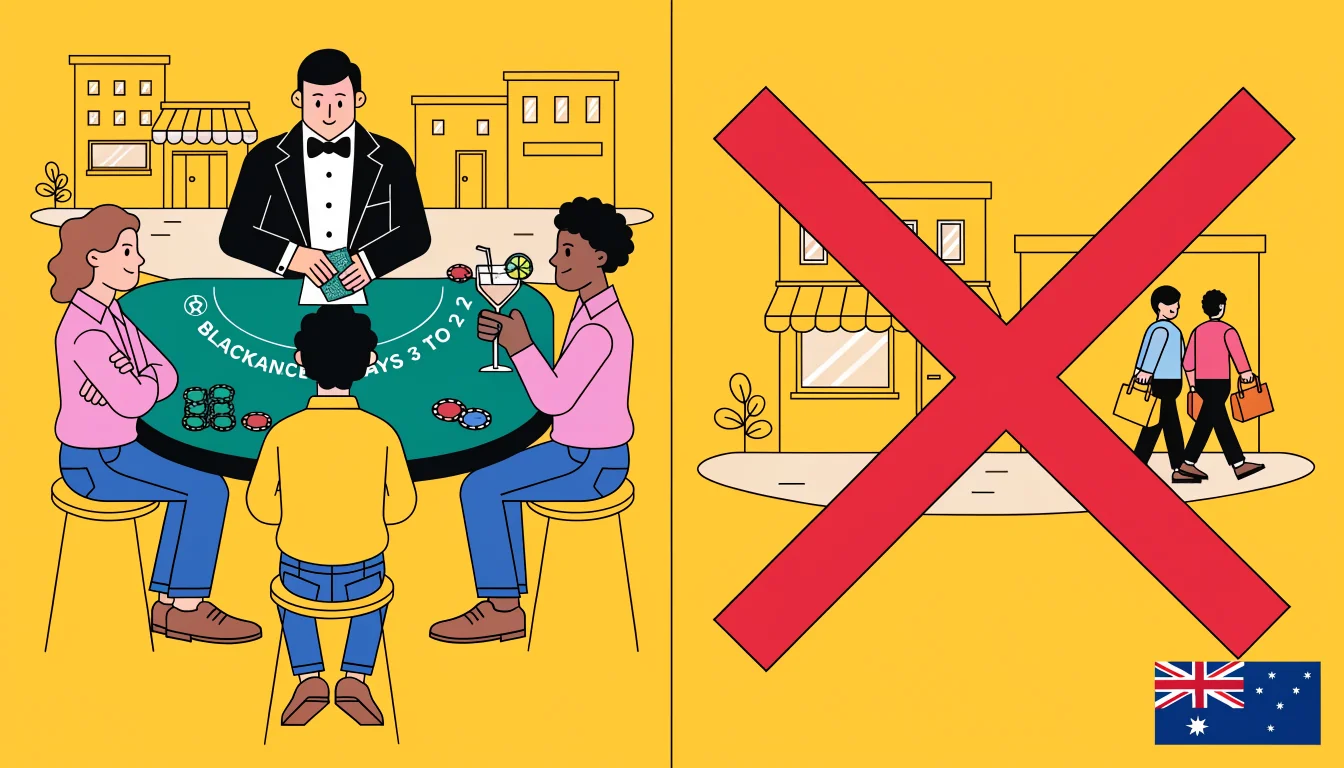
The confusion comes from a real distinction that gets flattened in casual conversation. Live betting by phone is legal. Ring a bookmaker, place a bet on the next over or the next point while the match is running — that’s permitted. Do the same thing through an app or a website, watching the odds shift in real time on a screen, and the transaction becomes illegal under federal law. Same bet, same moment, same market. The medium is what changes its legal status, not the wager itself. It’s an odd line to draw until you remember the law was written for a different era of gambling and never got a clean rewrite for streaming and live odds feeds.
Why the phone carve-out exists
The Interactive Gambling Act 2001 is the piece of Commonwealth legislation doing all this work, and its stated purpose is harm minimisation rather than blanket prohibition of gambling itself. Phone betting predates the interactive gambling framework and was treated as a continuation of an established, lower-risk channel. Online in-play betting, with its rapid-fire micro-markets and constant visual feedback, was judged to carry a different risk profile — closer to the kind of compulsive, fast-loop wagering the Act was built to blunt. Whether that judgment still holds up against a world where phone apps offer live odds updates every few seconds is a fair question. Nobody’s rewritten the law to answer it.
Live Betting Restriction
Live in‑play betting via apps or websites is illegal in Australia, even though phone‑based betting is allowed. Engaging in live dealer or live‑betting services can breach the law.
Where table games and live dealers actually sit
Live dealer tables — roulette wheels spun by a real croupier, blackjack dealt by a person on camera — fall under the same prohibition that covers online casino, poker, and in-play betting generally. The Act doesn’t carve out a special category for "live" as a production style; it draws its line around in-play wagering and casino-style games as a whole, and streamed table games sit inside that boundary regardless of how the offer is packaged. A site calling something "live" doesn’t put it in a different legal bucket. It’s the same offshore-supplied casino content as any slot reel, just with a camera pointed at a dealer instead of a random number generator running the show.
Who can actually do something about it
This is where the table games question splits from the slots conversation in a way worth naming directly. Each state and territory runs its own gambling regulator — Liquor & Gaming NSW, the Victorian Gambling and Casino Control Commission, and others operate independently of each other and of the federal system. But their authority was built for licensed venues and local operators. Against an offshore site streaming live blackjack from outside Australian jurisdiction, that authority runs out fast. State regulators can act on domestic advertising, domestic partners, domestic land-based casinos. They have limited reach into a server sitting overseas.

That leaves the federal side carrying the actual enforcement weight, and even there the toolkit is narrower than people assume. The Australian Communications and Media Authority can investigate a prohibited interactive gambling service and can move to block it. What it cannot do is get anyone’s money back. If a live dealer session goes wrong — a dispute over a hand, a frozen stream mid-bet, a balance that vanishes — there’s no regulator picking up that specific complaint and settling it on the player’s behalf. ACMA’s power stops at the service, not at the transaction history sitting inside it.
ACMA does have one tool that reaches slightly further than blocking a website: it can write to software developers and other third parties considered ancillary to a breach of the Act. That covers the technical layer behind a live-streamed table — the platform provider running the video feed, the software supplying the game engine — not just the operator’s own domain. It’s a slower, less direct form of pressure than shutting a site down outright, and it doesn’t undo a dispute already in progress. It’s aimed at the supply chain, not the account balance.
None of this makes offshore live tables invisible to enforcement. It makes disputes over them effectively unrecoverable through any Australian authority. Different mechanism than a pokies payout query, same conclusion either way.
No refund line to call.

Payments and Deposits: Accepted Methods for Australian Players
There’s no such thing as a "payments page" for an Australian online casino, because there’s no such thing as a licensed Australian online casino. That distinction matters more here than anywhere else in this piece. Every payment conversation about offshore sites happens in a legal vacuum — nobody at ACMA is approving deposit methods, because ACMA’s job under the Interactive Gambling Act isn’t to regulate how money moves into these platforms. It’s to stop the platforms operating for Australian residents at all. Sources differ on which year the relevant prohibition dates back to — some cite the 1997 Act, others the 2001 version — but the practical outcome hasn’t changed: offering these games to Australians has been off-limits for a long time, and payment processing sits downstream of that ban, not inside it.
That’s worth sitting with for a second. When I worked adjacent to payment operations, the question "which deposit methods are compliant" got asked constantly by people who assumed compliance meant something at the platform level. It doesn’t, not here. A payment method being "accepted" by an offshore casino tells you nothing about whether that casino is allowed to serve you. It only tells you what their processor will route.
What actually gets used
Offshore operators serving Australian players typically build their payment stacks around whatever their licensing jurisdiction and banking partners will tolerate — Curacao-licensed platforms lean one way, Kahnawake-licensed platforms another. None of this is verified or endorsed by any Australian body, because no Australian body has jurisdiction over it. What you’ll commonly encounter:
- Bank transfers and e-wallet services, processed through intermediaries outside Australia’s regulated banking perimeter
- Cryptocurrency, including Bitcoin and Ethereum, favoured by some platforms precisely because it routes around conventional banking oversight
I’m not going to pretend that list is exhaustive or stable. Offshore payment rails change when banks get nervous, when processors get flagged, when a jurisdiction tightens its own rules. Anyone claiming a fixed, current menu of "accepted methods" for offshore casinos is describing a snapshot that’s already aging.
The enforcement angle, not the payment angle
Where ACMA actually shows up in this picture isn’t as a payments referee — it’s as the body that can order internet service providers to block a site outright. That power has been in use since November 2019, aimed at illegal offshore gambling operations generally, casinos included. The blocking doesn’t target a deposit method. It targets the site itself, at the network level. If the domain goes dark for Australian users, the payment conversation becomes irrelevant — there’s nothing left to deposit into.
Beyond blocking, ACMA can start civil proceedings, flag offending operators’ directors to border protection agencies, and coordinate with regulators overseas. None of that toolkit exists to certify a payment flow as safe. It exists to make the platform disappear.
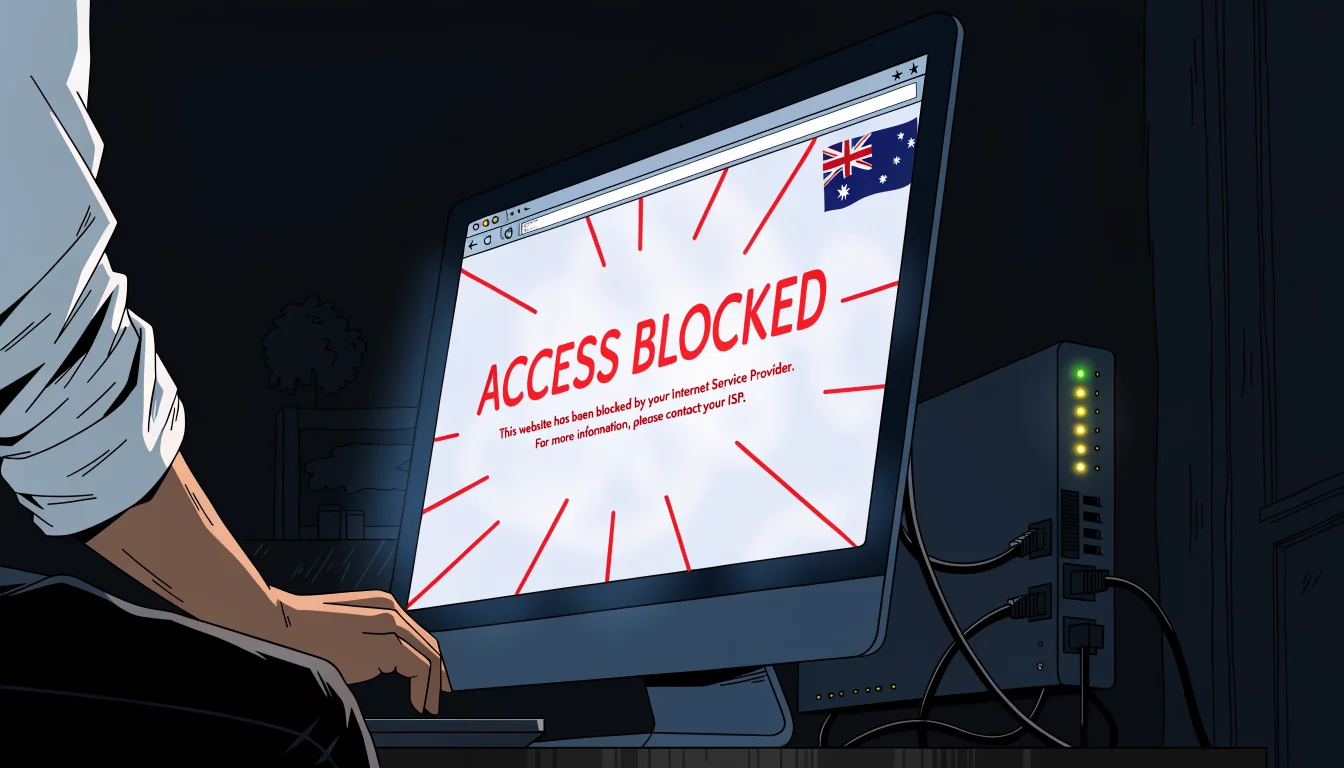
Two figures get cited for how many sites this has affected, and they don’t line up because they’re measuring different things at different points. One source, reporting through 2024, put the count of illegal gambling sites and affiliates blocked since 2019 at 975. Another, current as of August 2025, put the cumulative figure at 1,296 blocked sites and affiliates, with 220 services having exited voluntarily. Separately, one industry source (theiaga.org) reported over 100 illegal gambling services — casinos among them — leaving the market since ACMA’s enforcement ramped up in 2017. Read these as progressive snapshots from a moving enforcement campaign, not as a single settled statistic. The number keeps climbing because the blocking keeps happening.
Why this isn’t a "which method is best" question
Every guide that ranks payment methods by convenience is answering a question that assumes legitimacy on the other end. That assumption doesn’t hold here. A deposit method being fast or familiar — PayID, a bank transfer, a crypto wallet — says nothing about the legal status of the site receiving it. The method is neutral. The destination isn’t.
This is also where deposits and withdrawals part ways conceptually, even though they sit next to each other in most people’s minds. Depositing is the easy half: money moves one direction, through whatever rail the operator has managed to keep open. Getting money back out is a different mechanism entirely, with its own checks and its own friction — and that’s the next piece of this, not this one.

What stays constant is the absence of oversight on the deposit side. No Australian regulator certifies these payment corridors. No licence backs them. Whatever gets accepted, gets accepted outside the frame this law was built to enforce.
Withdrawals and Identity Verification Requirements
Getting money in is one conversation. Getting money out is a different one, and it’s the one operators would rather you didn’t ask too many questions about before signing up. Nothing in Australian law stops a resident from playing at an offshore-licensed casino — the Interactive Gambling Act 2001 targets the operator, not the individual — but nothing in that same law protects the player when a withdrawal stalls either. That gap is where most of the frustration lives.
Why identity checks come before your money does
Every legitimate operator, wherever it’s licensed, runs KYC (Know Your Customer) checks before releasing funds. This isn’t optional friction bolted on to slow you down for the sake of it — it’s the standard mechanism licensing bodies use to confirm the account holder is who they say they are, and that the funds aren’t moving somewhere they shouldn’t. In practice this means a copy of government-issued ID, sometimes a utility bill or bank statement to confirm address, occasionally a selfie holding the document.
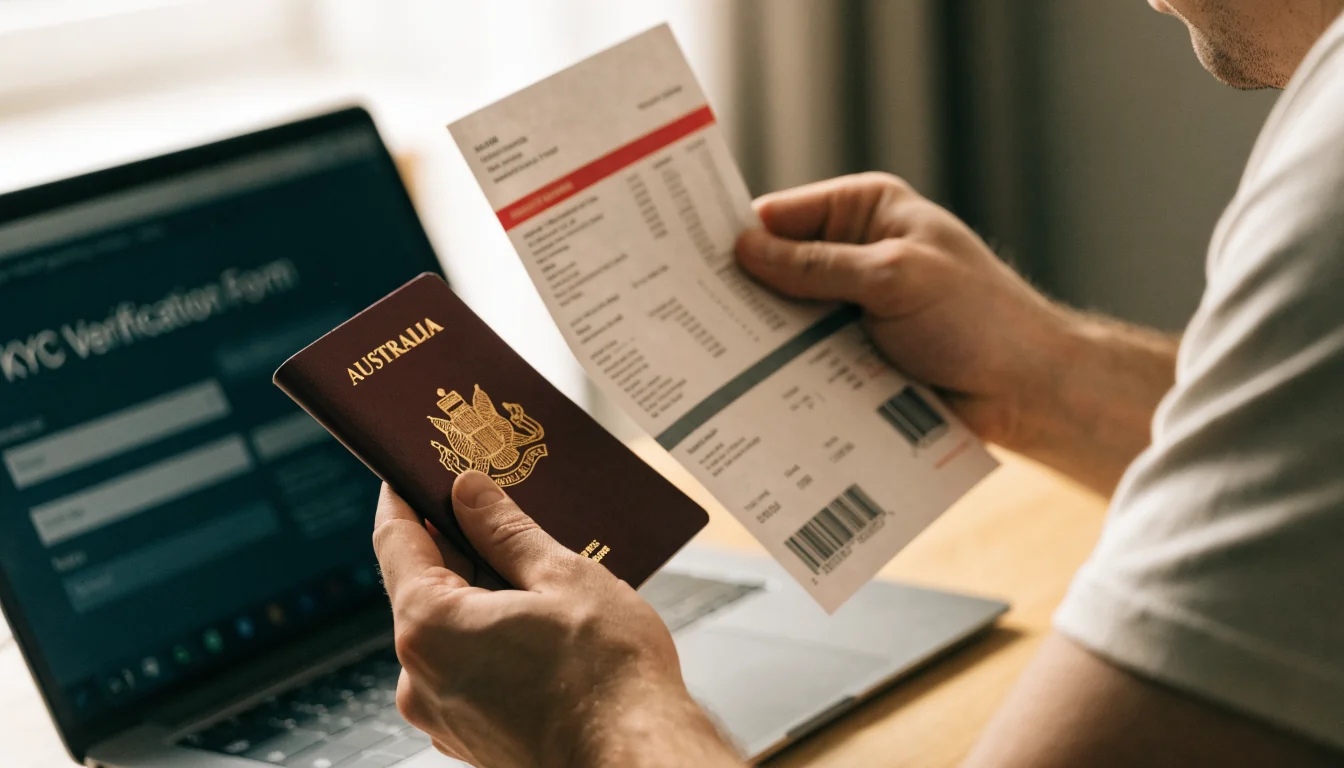
The timing is what catches people out. Deposit and you’re playing within minutes. Try to withdraw and suddenly the operator wants documents it never mentioned at signup. That’s not a coincidence — it’s the point at which verification is cheapest for the operator to enforce, because by then you already have a balance they’re holding.
None of this is unique to offshore casinos. It’s the same pattern licensed Australian sports betting operators use, since online sports betting is legal under state and territory licences and those bookmakers answer to real regulatory oversight. The Northern Territory Racing Commission licenses most of the national online bookmakers — largely because of the lower tax rate on offer there — and functions as Australia’s de-facto authority for online wagering as a result. A bookmaker licensed by the NTRC has a regulator to answer to if verification turns into an excuse for delay. An offshore casino generally doesn’t.
Where the protection actually stops
Land-based casinos sit in a completely different regulatory world. Those venues answer to state government regulators and law enforcement agencies, with inspectors, licensing conditions, and a physical address that isn’t going anywhere. Withdraw your chips at the cage and the transaction is governed by rules with teeth behind them.
Online casino withdrawals from offshore platforms have no equivalent. ACMA can request that internet service providers block sites offering games not permitted under Australian law — online casinos, online pokies, in-play sports betting — but blocking access to a site is not the same as recovering a balance stuck inside it. If an offshore operator drags out a withdrawal, invents a new document request, or simply stops responding, there’s no Australian regulator empowered to step in on your behalf. That authority doesn’t exist for this category, full stop.
According to boomaff.com, over 220 illegal gambling services have shut down in Australia as a result of ACMA’s enforcement actions. Whatever number is current by the time this is read, the pattern behind it matters more than the figure: operators exit, sometimes abruptly, and players with pending withdrawals are the ones left holding nothing. A casino that vanishes from the market doesn’t process the withdrawal it owes on the way out.
What actually happens at withdrawal stage
Realistically, the process looks like this:
- Request submitted — the player initiates a withdrawal through the account’s cashier section, usually back to the method used for deposit or a nominated alternative.
- Verification triggered — if KYC wasn’t completed at signup, it’s demanded now, before any funds move.
- Internal review — some operators run a manual check on account activity, betting patterns, or bonus conditions tied to the balance.
- Processing or delay — funds are released, or a further document request arrives, restarting the clock.
Each of those steps is a point where an operator without accountability can simply slow-walk the outcome. There’s no complaints body specific to offshore online casinos that an Australian player can escalate to with any real leverage — unlike a licensed bookmaker’s regulator, which at least has a paper trail to follow.
The advertising blind spot doesn’t help
Part of why players end up trusting operators they shouldn’t is that the warning signs rarely show up where regulation can reach them. ACMA has no power to force platforms like Facebook to block gambling ads targeting Australian users, because the law’s wording prohibits advertising "in Australia" — a phrase that doesn’t cleanly cover ads served from overseas to an Australian screen. Slick promotion keeps arriving. Regulatory reach stops at the border.
Identity verification, then, isn’t the obstacle worth resenting. It’s one of the few checkpoints in the entire process where an operator is forced to slow down and confirm who’s on the other end. The real risk sits one step later — at the point where the money is supposed to come back, and there’s no one whose job it is to make sure it does.
Game Providers Operating for Australian Audiences
Every game running on an offshore casino site — the pokies, the roulette wheel, the live dealer feed — comes from a studio, not from the casino brand itself. Pragmatic Play, Microgaming, NetEnt, Evolution Gaming: these names sit in the background, licensing their software to dozens of operators at once. The casino you’re looking at is usually a storefront. The provider is the warehouse.
That distinction matters more in Australia than it does elsewhere, because nobody here is licensing either side of that arrangement.
Who actually regulates this
There’s no single authority that oversees gambling in Australia. Regulation splits between the states and the Commonwealth, and it splits again within each of those levels. Each state and territory runs its own gambling regulator — Liquor & Gaming NSW, the Victorian Gambling and Casino Control Commission, and others, each with its own remit. None of them licenses online casino games. None of them can, because offering online casino gambling in Australia is illegal outright, and there’s no path to a domestic licence for it — not for the casino, not for the software running underneath it.
So when a provider’s logo appears on an offshore site serving Australian players, that logo represents a licence issued somewhere else entirely — Malta, Curaçao, Kahnawake. The provider answers to that foreign regulator. It does not answer to Sydney or Melbourne.
The VGCCC is the interesting exception here, in a limited way. It monitors wagering service providers for compliance with the National Consumer Protection Framework regardless of which state they’re based in — a genuinely cross-border reach, at least domestically. But that framework was built for licensed wagering operators inside the country. It has nothing to grip onto when the operator, and the software behind it, sit offshore. State regulators, VGCCC included, have limited power once the server and the studio are both outside their jurisdiction. "Monitoring" here doesn’t mean "controlling."

What ACMA can and can’t touch
At the federal level, ACMA enforces the Interactive Gambling Act, and its reach extends a step further than the states’ does — but not as far as people assume. ACMA can investigate a prohibited interactive gambling service and order it blocked. What it can’t do is recover a player’s funds or settle a dispute between a player and an offshore operator. That’s a private commercial relationship played out under a foreign licence, and ACMA was never built to referee it.
There’s a quieter power worth knowing about, though: ACMA can issue letters to software developers and other third parties it believes are ancillary to a breach of the Act. That’s the closest the framework gets to reaching a game provider directly, rather than just the casino brand distributing the games. It’s a warning shot, not a takedown — the provider is still licensed and operating legally under its own regulator abroad. But it shows the line isn’t drawn only around the casino front-end. The people supplying the actual games aren’t automatically outside the conversation, even if they’re outside the country.
What this means in practice
None of this means the games themselves are somehow "certified for Australia" or vetted by anyone here. They aren’t. A provider’s licence from Malta or Curaçao says something about how that provider is regulated in that jurisdiction — audit requirements, RNG testing, dispute processes that apply there. It says nothing about Australian consumer protection, because Australian consumer protection for online casino content doesn’t exist. There’s no register to check, no domestic seal of approval to look for, because the entire category sits outside what any Australian body licenses.
That’s the part rarely spelled out on the casino side. The provider names get listed like credentials — as if "powered by" a recognisable studio settles the question of legitimacy. It settles a narrower question: whether the software is built by a company with a genuine offshore licence and a track record, rather than an unregulated shell. Worth knowing. Not the same as worth mistaking for local oversight.
If a dispute goes wrong with a specific game — a malfunction, a disputed result — the path runs through the offshore operator’s own complaints process and, behind that, its foreign regulator. Not through ACMA, not through any state body. Know that before it comes up, not after.
Created by the ”Casino Features Guide” editorial team.